

Whalefall ; A Survival Nightmare Inside the Belly of Grief
Produced by Imagine Entertainment and distributed by 20th Century Studios, Whalefall is a survival thriller about a young scuba diver who is swallowed by a sperm whale while searching for the remains of his estranged father. Trapped inside the animal with approximately one hour of oxygen, he must improvise an escape while confronting the grief and guilt that brought him into the ocean.
On paper, Whalefall sounds like a concept designed to generate immediate curiosity: a man becomes trapped inside a whale and has one hour to escape.
It could easily have become a campy creature feature built around biological absurdity and increasingly outrageous obstacles. Instead, Brian Duffield approaches the material as a sincere combination of underwater survival thriller, body horror, and family drama.
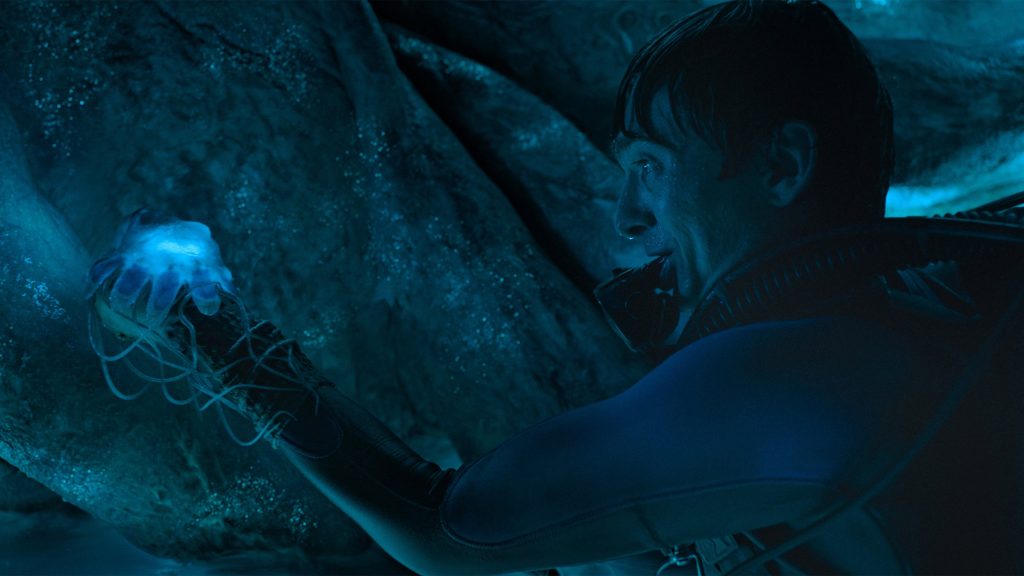
Austin Abrams plays Jay Gardiner, the youngest son of respected diving captain Mitt Gardiner. One year after Mitt’s death, Jay returns to California still carrying unresolved anger, guilt, and regret over their fractured relationship.
Mitt’s body was never recovered. Hoping to bring something home that his family can finally bury, Jay makes the reckless decision to conduct an unauthorized solo dive near a submarine canyon. An encounter involving a giant squid and a sperm whale transforms that search for closure into an almost impossible fight for survival.
The film understands that audiences will need to suspend disbelief. Its smartest decision is refusing to apologize for the premise. Once Jay is swallowed, the screenplay commits to the physical danger while treating his emotional crisis as seriously as the limited oxygen supply.
The Whale Becomes a Living Prison
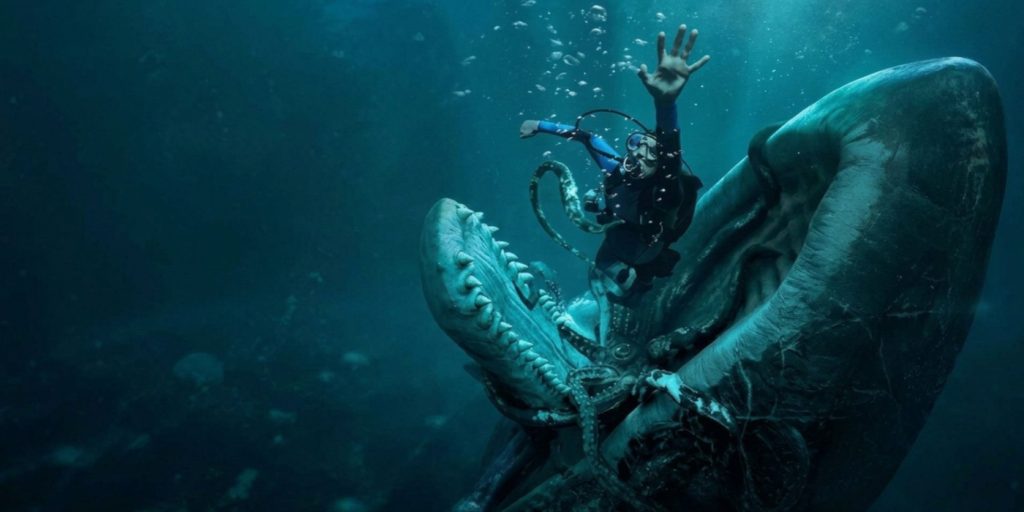
A conventional survival thriller usually traps its protagonist in a fixed environment: a cave, a collapsed building, a damaged spacecraft, or the bottom of the ocean. Whalefall makes that environment a living animal.
The whale’s interior contracts, shifts, fills with corrosive fluids, and changes pressure as the animal moves through the sea. Jay is not merely inside an enclosed location. He is trapped in a biological system that continues to feed, dive, breathe, and defend itself regardless of whether he survives.
That distinction gives the film its most original set pieces.
The internal chambers are neither anatomically comfortable nor visually clean. Surfaces move under Jay’s hands, fluids damage his equipment, and every available object is covered in organic matter. The environment feels wet, unstable, and constantly hostile.
Production designer Ramsey Avery’s enclosed sets give the whale’s interior physical weight, while cinematographer Aaron Morton shifts from the vast darkness of the ocean to oppressive, muddy frames that restrict Jay’s movement and the audience’s vision. One practical whale set constructed for production reportedly measured approximately 12 feet tall and 18 feet wide.
The decision to include a substantial practical environment matters. Jay appears to push against surfaces rather than floating through an entirely digital space. The whale’s body reacts to his movement, creating a sense that the walls of his prison could crush him at any moment.
Austin Abrams Carries the Film
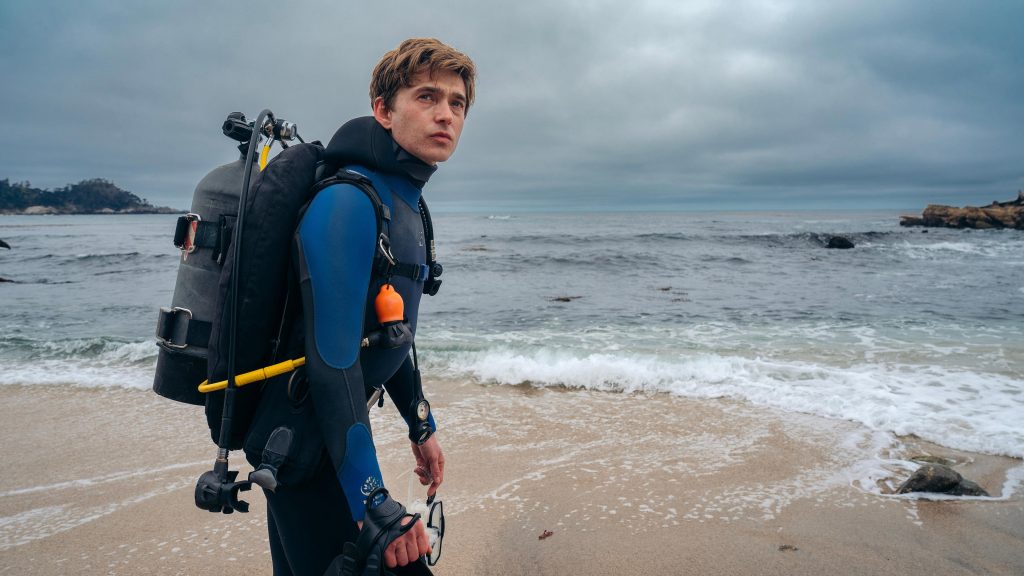
Most of Whalefall depends on one performer. Once Jay enters the whale, Austin Abrams must hold the audience’s attention through panic, physical exhaustion, pain, technical problem-solving, and fragmented memories. He delivers the film’s strongest element.
Jay is not introduced as a conventional survival hero. His decision to dive alone is reckless, emotionally driven, and contrary to basic safety principles. He enters the ocean in a state of grief rather than readiness, bringing limited air and no dependable rescue plan.
That makes him frustrating, but it also makes his behavior believable. Jay is not pursuing his father’s remains because he has carefully evaluated the risks. He is attempting to convert emotional pain into a practical mission. If he can recover something tangible, perhaps he can give his family a burial and give himself an ending.
Austin Abrams communicates that desperation beneath the physical performance. The film frequently places the camera close to his face, leaving him nowhere to hide. His breathing, eye movement, and deteriorating concentration become essential indicators of his remaining strength.
The performance was also physically demanding. Available production information indicates that Austin Abrams performed almost all of his stunts, including underwater work in scuba equipment.
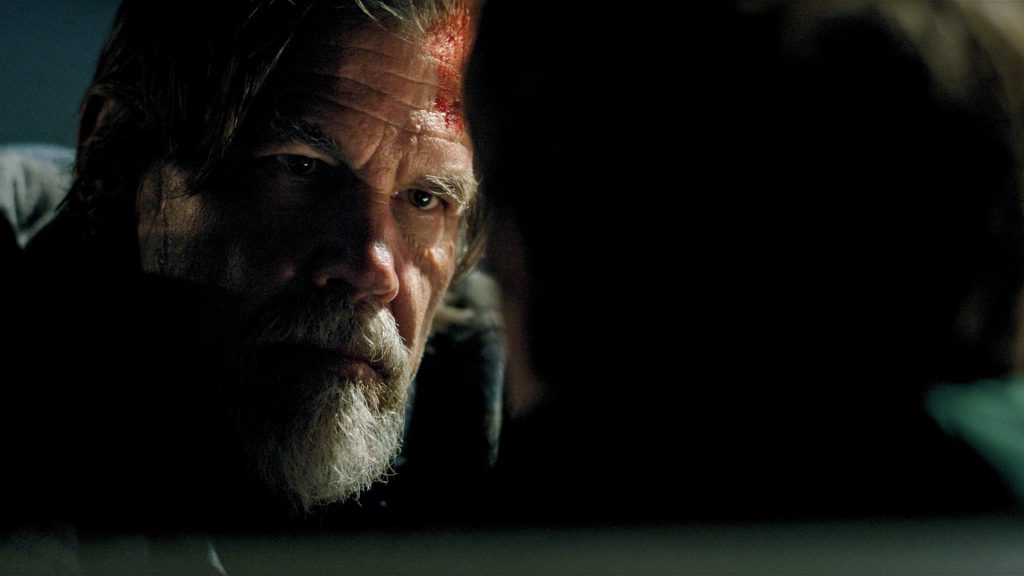
Josh Brolin plays Mitt Gardiner, Jay’s estranged father. Because Mitt has died before the main survival story begins, he appears primarily through memories and hallucination-like conversations.
Mitt is portrayed as an accomplished diver with an abrasive personality. He knows how to survive in the ocean, but his toughness frequently becomes emotional cruelty. His lessons prepare Jay for danger while simultaneously damaging the relationship between them.
The film does not reduce Mitt to an inspirational father whose wisdom becomes meaningful only after his death. He could be volatile, controlling, and abusive. Jay’s grief is therefore complicated by resentment. He misses his father, but he also remembers why he stayed away.
That contradiction is central to the story. Jay is not searching for the remains of a man he understood completely. He is searching for an answer to a relationship that ended before either of them could repair it.
Josh Brolin makes Mitt physically and emotionally intimidating without stripping away every sign of care. The character’s survival lessons often arrive through aggression, yet those same lessons later become part of Jay’s attempt to stay alive.
A Terrifying Experience for Claustrophobic Viewers
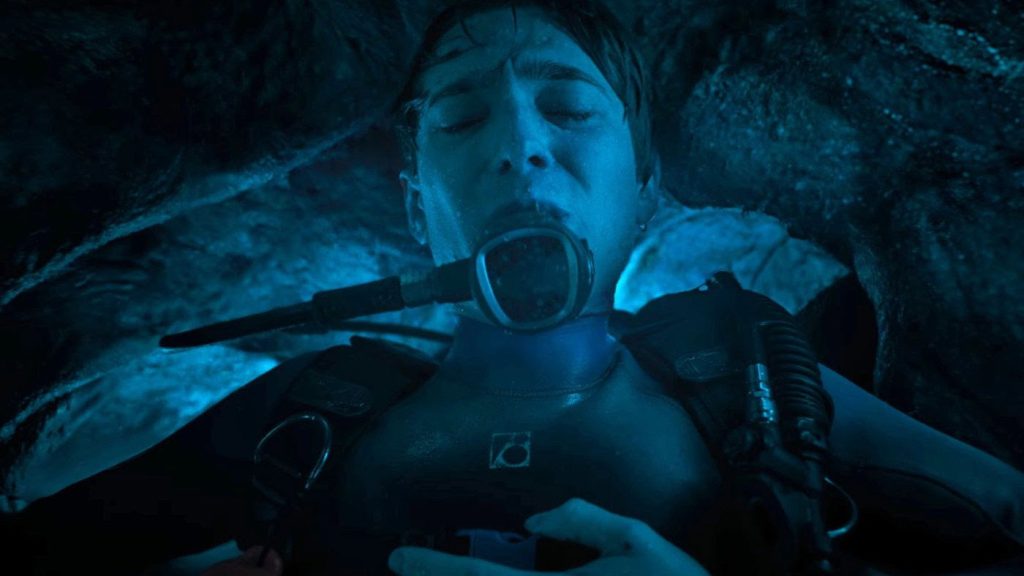
Whalefall operates at the intersection of two fears: thalassophobia and claustrophobia. Before Jay is swallowed, the ocean is presented as a space without reliable boundaries. Light disappears beneath him, visibility becomes limited, and enormous creatures move through an area humans can neither control nor properly observe. Afterward, that vastness is replaced by extreme confinement.
The transition is effective because neither environment feels safe. The open ocean makes Jay appear insignificant, while the whale’s body gives him almost no room to move. Freedom and imprisonment become equally dangerous.
Sound design is crucial to sustaining that anxiety. Deep clicks, muffled impacts, moving fluid, Jay’s breathing, and the mechanical signals from his equipment make the environment feel larger than the visible frame. Screen Daily specifically highlighted the use of sonar booms and echoing clicks in creating the film’s otherworldly underwater atmosphere.
The most intense scenes do not always involve direct attacks. Watching the oxygen gauge fall or hearing Jay’s breathing accelerate is often more effective than the larger visual effects.
Every decision consumes energy. Every movement risks damaging his equipment. Panic itself becomes a threat because it accelerates his breathing and shortens the narrow window available for escape.
Body Horror Inside a Survival Thriller
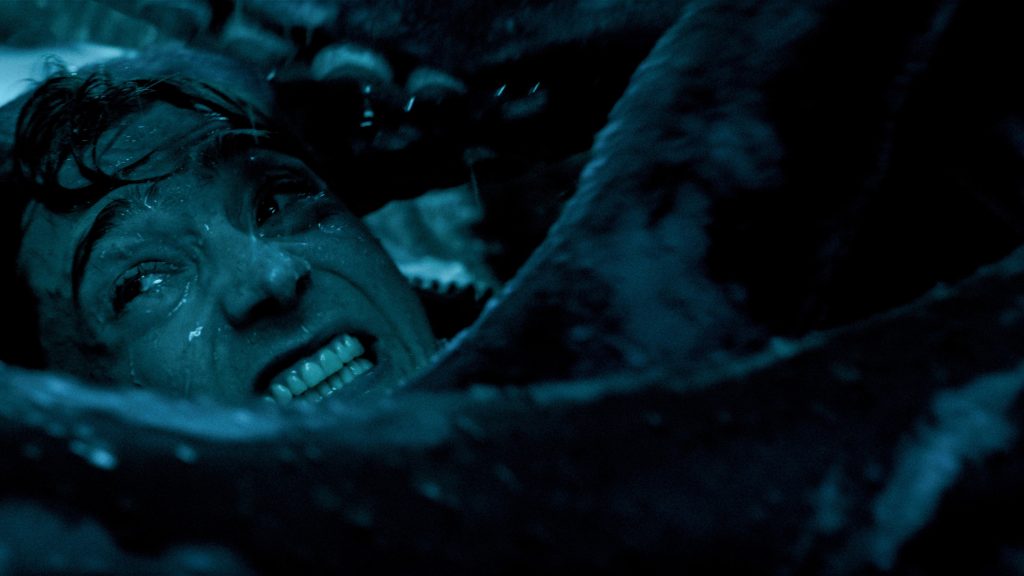
The film also embraces body horror more strongly than its adventurous marketing might suggest.
Jay encounters digestive fluids, constricting tissue, decomposing organic matter, and injuries caused by his surroundings. His body deteriorates as the whale’s internal system continues functioning around him.
These sequences are uncomfortable because the danger is intimate. Jay cannot simply fight a monster standing across from him. The monster is the environment, and that environment is reacting biologically rather than maliciously.
The whale is not framed as a villain. It does not hate Jay or intentionally imprison him. He is an accidental intrusion into its body, just as the animal becomes an unwilling vehicle for his survival story. That distinction prevents the film from becoming an uncomplicated man-versus-beast narrative. Jay wants to escape, but the whale is also fighting to live.
The title adds another layer to this relationship. A “whale fall” occurs when a dead whale sinks to the seabed and its body supports an ecosystem of deep-sea life. The idea that death can generate new life becomes an explicit metaphor for Jay’s relationship with his father.
Mitt’s death threatens to consume Jay, but the memories and knowledge he left behind may also help his son survive.
The Science Requires Considerable Suspension of Disbelief
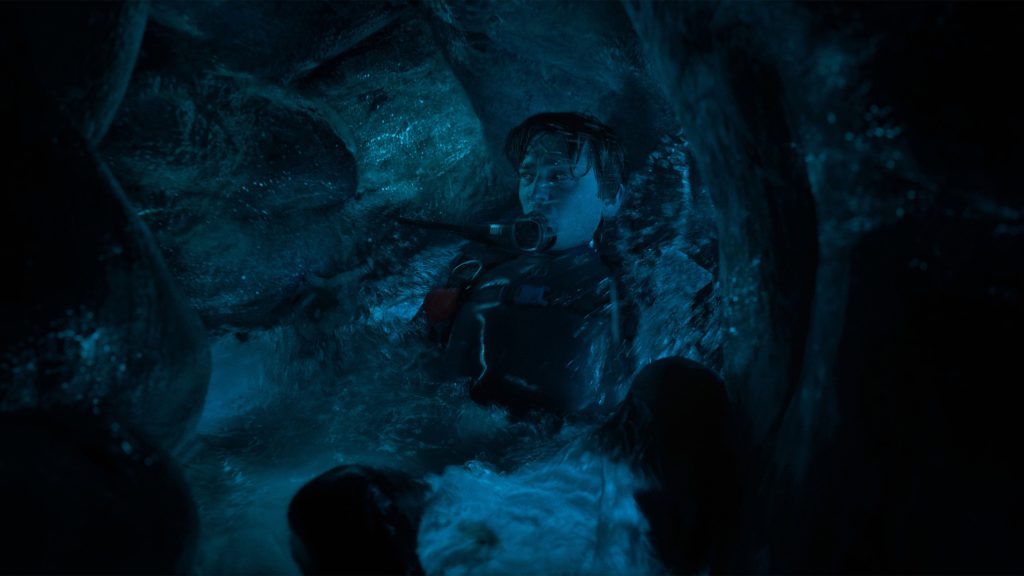
The film’s largest vulnerability is biological and physical credibility. A sperm whale’s anatomy, pressure changes during rapid movement, the availability of breathable space, the effects of digestive conditions, and Jay’s ability to move between internal chambers all require generous suspension of disbelief.
The screenplay offers practical explanations whenever possible. Jay uses pieces of diving gear, material from the whale’s recent prey, and remembered survival principles to solve immediate problems. Those details make the escape attempts engaging because they are built from objects already present in the environment.
The Flashbacks Occasionally Break the Pressure
The flashbacks involving Jay and Mitt are necessary. Without them, the story would be a technically creative but emotionally thin escape exercise. Yet the film relies on them too frequently.
At its strongest, Whalefall creates momentum from limited air, physical injury, rising pressure, and the unpredictable movement of the whale. Cutting away from that urgency can release tension that the next sequence must rebuild.
Certain memories also repeat information. The audience quickly understands that Mitt was a gifted diver, a difficult father, and a source of both knowledge and pain. Later flashbacks sometimes reinforce those points rather than complicating them.
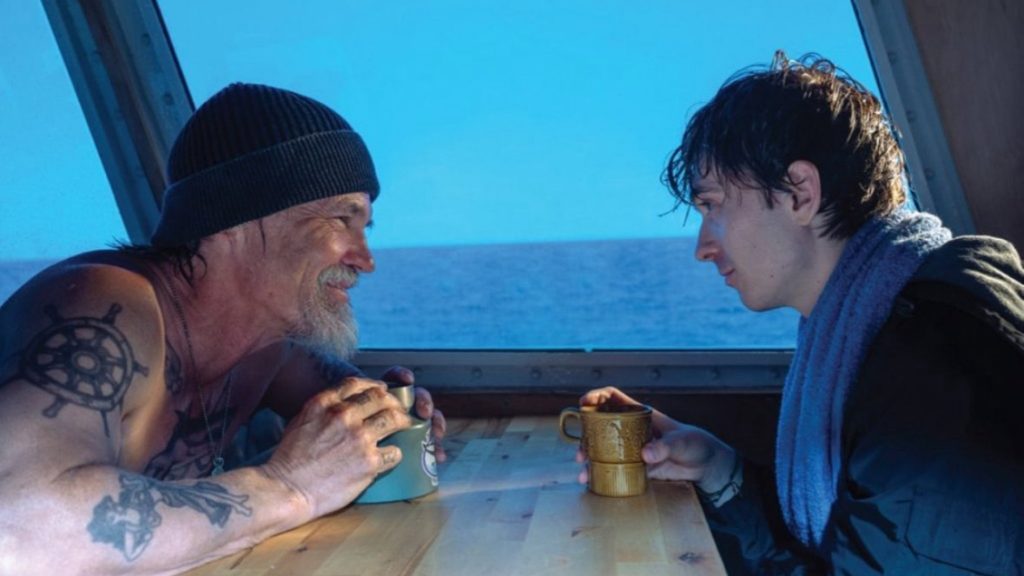
A more restrained structure might have trusted the audience to build its understanding from fewer, sharper memories. This would also have given Josh Brolin’s appearances greater force.
Nevertheless, the emotional storyline remains essential to the film’s identity. Removing too much of it would turn Jay’s journey into a mechanical race against oxygen, eliminating the reason he entered the ocean in the first place.
Whalefall transforms an outrageous premise into an emotionally committed survival thriller about grief, guilt, and the complicated legacy of a damaging parent.
Austin Abrams gives the film the physical exhaustion and emotional vulnerability it needs. His performance keeps Jay human even when the narrative moves toward increasingly improbable solutions. Josh Brolin is equally effective in a smaller role, portraying Mitt as a father whose knowledge and cruelty have become inseparable in his son’s memory.
The whale’s interior provides the film with a distinctive visual identity. Practical sets, oppressive cinematography, detailed sound design, and uncomfortable body horror turn it into a living prison unlike the fixed environments of most survival stories.
Its emotional ambitions are not always handled with restraint. Some flashbacks disrupt the tension, several metaphors are explained too directly, and the escape mechanics eventually demand substantial suspension of disbelief.